
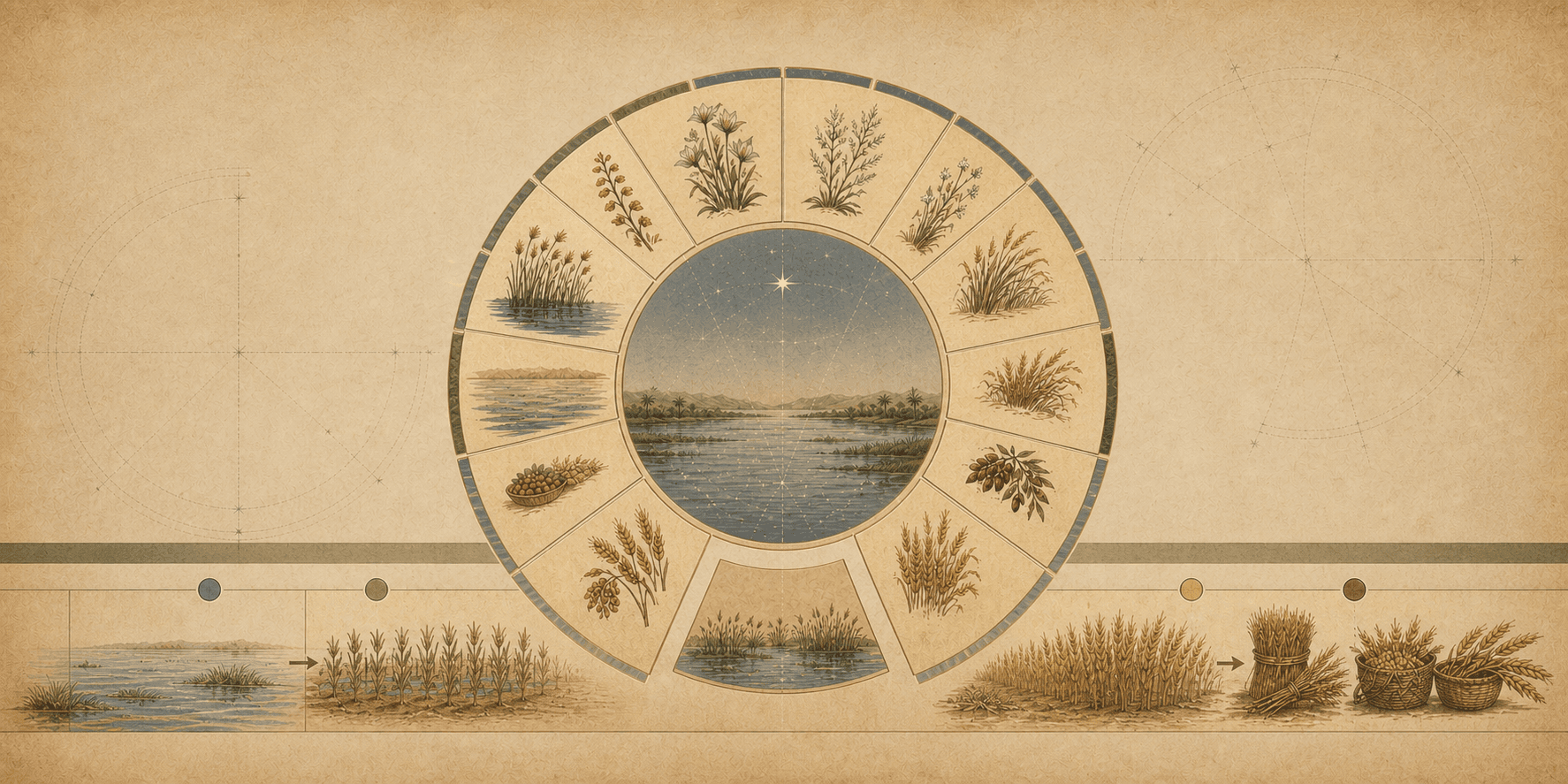
What the Gebti Calendar Is, and What It Is Based On
What the Gebti calendar is
The Gebti calendar is not a separate astronomical system built from scratch. It is a modern presentation of the Coptic calendar with a different year count. In practical terms, it keeps the same months, the same month lengths, and the same leap-year rule used in the Coptic or Alexandrian calendar. What changes in Gebti is not the structure of the year, but the way the year number is framed.
Its historical base
Its historical basis lies in the long relationship between the Coptic calendar and the older Egyptian civil calendar. Ancient Egypt used a 365-day civil year divided into twelve 30-day months, followed by five extra days at the end of the year. That basic structure is one of the oldest known civil calendar systems in human history.
Egyptian timekeeping was also connected to the Nile cycle and to astronomical observation, especially the seasonal importance of Sirius. But precision matters here: the classical Egyptian civil calendar itself did not use the later leap-day correction. Because of that, it drifted slowly through the solar year over long periods.
Its scientific base
The Coptic or Alexandrian calendar preserves the old Egyptian month framework in a regularized form. It has 13 months: twelve months of 30 days, then a short final month of 5 days, or 6 in leap years. The month names still in use today are Coptic forms of older Egyptian names, which is why the system retains a clear historical continuity even though its later form was standardized in late antiquity.
That is the scientific basis of the calendar used on Gebti: it is fully rule-based and computable. Any Gregorian date can be converted into a Gebti date through fixed arithmetic rules for day counts, leap years, and month boundaries. In other words, this is not just a symbolic heritage label; it is a working calendar.
What makes it "Gebti"
The specific Gebti feature in this project is the year offset. In Gebti, the displayed year equals the Coptic year plus 4525. This offset is a modern Gebti convention intended to place the living Coptic calendar inside a longer Egyptian historical frame, while leaving the month system unchanged.
So the strongest accurate claim is a narrow one: Gebti is historically grounded because it builds on the Coptic calendar, and the Coptic calendar preserves major structural features of the older Egyptian civil calendar. It is not a claim that every detail of the pharaonic calendar survived unchanged. It is a modern, explicit reconstruction of continuity between a living Egyptian calendar tradition and a deeper historical chronology.