
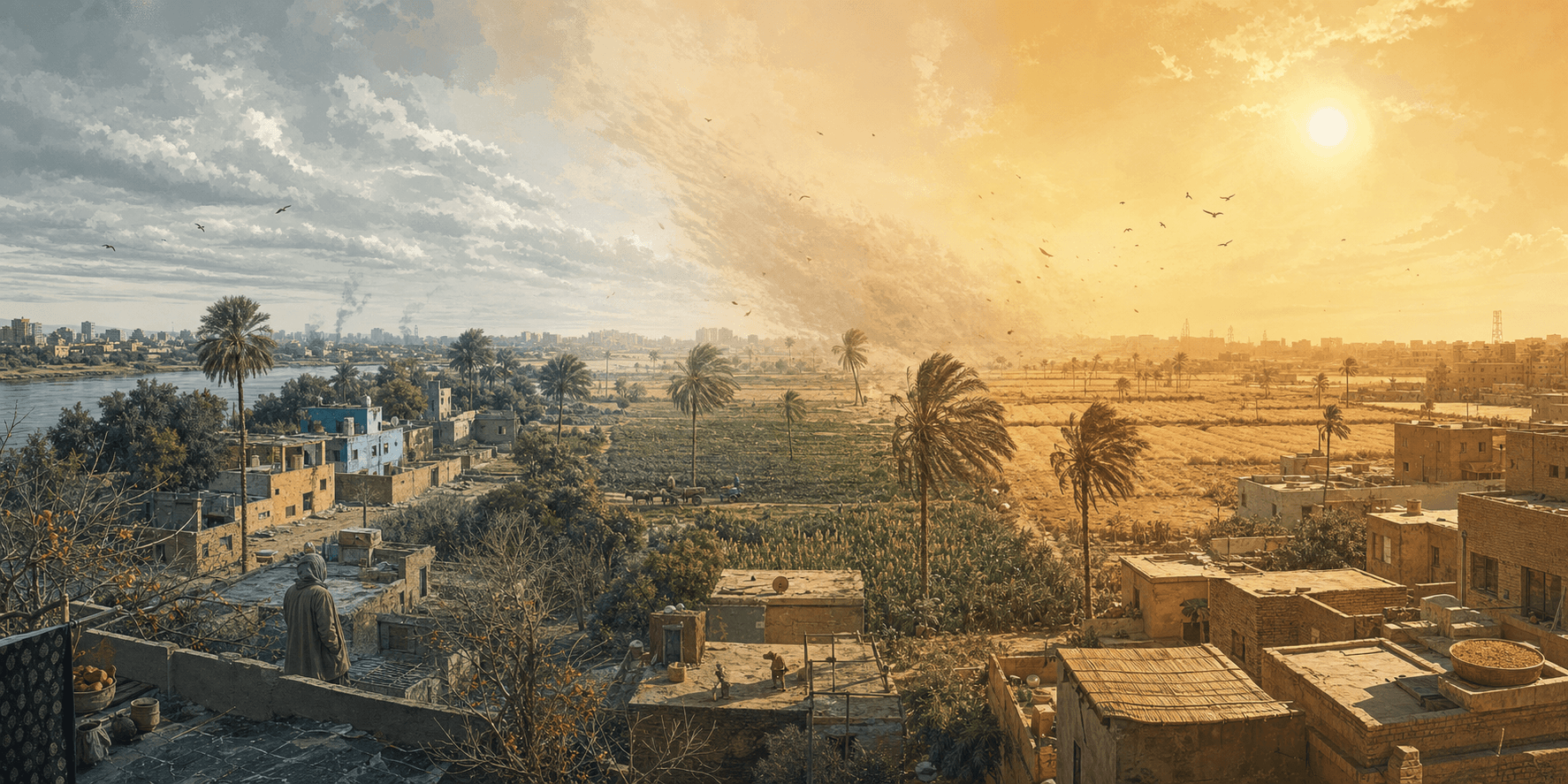
How Egyptians Read the Year Through Weather
Long before weather apps and forecasts, Egyptians read the year through air, water, crops, and the changing behavior of the sky. The old Egyptian calendar was never only a way to count days. It was also a practical map of what the land was doing and what kind of weather people were likely entering.
That is why old month names and seasonal categories lasted. They were useful. They helped people anticipate cold, rising wind, bloom, harvest pressure, and the hardening of summer. Even now, many of those associations survive in ordinary speech.
The three great seasons of the Egyptian year
In the Egyptian calendar used through the Coptic tradition and echoed in everyday memory, the year is organized into three full seasons of four months each, followed by the short small month at the end of the year.
Akhet begins on 1 Thout and ends on 30 Kiahk. That is months 1 to 4: Thout, Paopi, Hathor, and Kiahk. Historically this is the season of inundation. In the modern climate sense, it covers the turn into cooler weather and the slower descent toward winter.
Peret begins on 1 Tobi and ends on 30 Paremoude. That is months 5 to 8: Tobi, Meshir, Paremhat, and Paremoude. Historically this is the season of emergence and growth. In lived weather, it holds the deepest winter cold, the rough winds, and then the first clear signs of spring.
Shemu begins on 1 Pashons and ends on 30 Mesori. That is months 9 to 12: Pashons, Paoni, Epip, and Mesori. Historically this is the harvest season. In weather terms, it is the long movement into dry heat, field exhaustion, and full summer pressure.
After these comes Pi Kogi Enavot, the small month known in Arabic as al-Nasie. It is month 13, only five days long in a common year and six in a leap year. It sits at the edge of the year as a short hinge rather than a full season.
Rough Gregorian anchors
For a modern reader, the seasons usually begin around these Gregorian dates: Akhet around September 11, Peret around January 9, Shemu around May 9, and the small month around September 6. The exact Gregorian alignment can shift by a day depending on leap-year rules, but the internal Egyptian calendar structure stays the same.
The weather turns people still recognize
Tobi is where many people place the serious bite of winter. Nights feel heavier, mornings sharper, and the year finally settles into cold rather than just cooling down. This is one reason Toba remained such a strong word in Egyptian memory.
Meshir is the famous wind month. When people say Amshir, they usually mean unstable air, strong gusts, dust, and weather that refuses to behave. It is less a neat season than a temperament inside the calendar.
Paremhat and Paremoude form one of the most sensitive turning zones in the year. Winter does not vanish all at once, but the air begins to loosen, fields begin to answer, and blossoms become part of the landscape again. At the same time, hotter gusts and dusty interruptions can begin to appear.
From late Paremoude into Pashons, people begin to feel the door opening toward khamsin-like weather: dry, hot, dusty spells that do not yet mean full summer, but clearly announce its approach. This is a transition people often feel physically before they describe it formally.
By Paoni, Epip, and Mesori, the year is no longer turning. It has hardened. Heat becomes steadier, shade matters more, and the day feels less negotiable. This is not only the hot season in a generic sense. It is the long Egyptian summer as lived on roofs, in streets, and across cultivated land.
What the calendar really preserved
The old Egyptian calendar does not work like a modern forecast. It does something more human. It preserves patterns. It tells you what kind of weather character the land is entering, what work becomes easier or harder, and what mood the year is carrying.
That is why weather words tied to the Egyptian calendar survived. They are not only old names. They are compressed local knowledge. To say Toba, Amshir, or Baramhat is to describe a time of year in a specifically Egyptian way, with memory, climate, and language all folded together.