
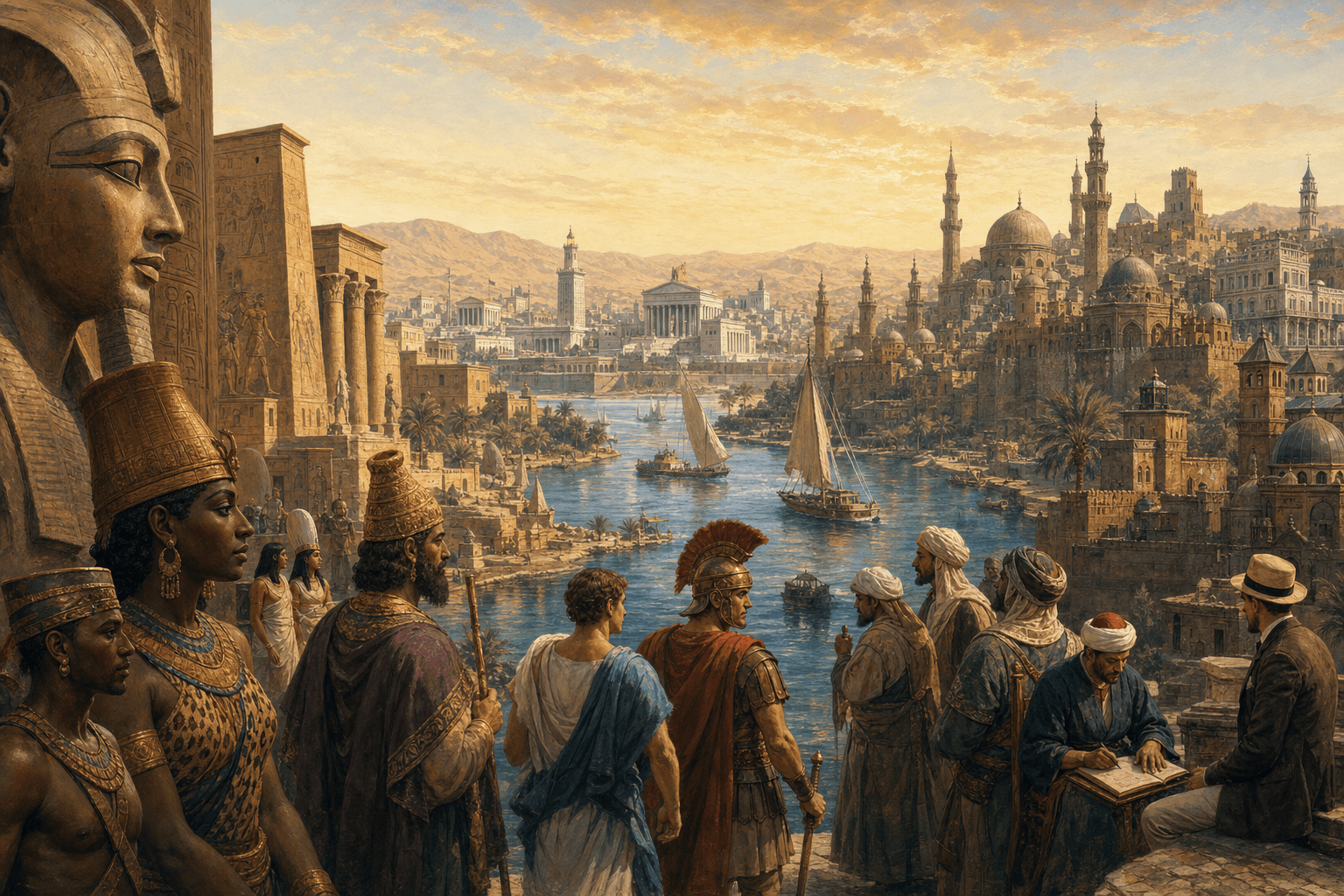
The Cultures That Passed Through Egypt, and the Egypt They Changed
Egypt is often described as one of the oldest continuous civilizations on earth, and that is true. But continuity does not mean isolation. For thousands of years, Egypt was also a crossroads: a place people entered, ruled, traded through, studied in, fought over, and absorbed into their own maps of the world.
A Country That Absorbed Without Disappearing
What makes Egyptian history remarkable is not simply the number of outside cultures that passed through it. It is the way Egypt repeatedly absorbed foreign influence without losing its own center of gravity. New rulers came, new languages appeared, new armies marched in, and new religions spread. Yet Egypt kept turning those pressures into something local.
Nubian and Kushite Ties
To the south, Nubia was never just a distant neighbor. Egypt and Nubia exchanged trade, military power, religion, and royal symbolism for centuries. At some moments Egypt dominated Nubia; at others, Nubian rulers moved north and ruled Egypt themselves. The Kushite pharaohs of the Twenty-Fifth Dynasty are one of the clearest examples of a culture passing into Egypt and reshaping it from within rather than from the margins.
Persian, Greek, and Roman Layers
The Persian empires treated Egypt as a strategic province. Alexander then entered Egypt and opened the Hellenistic age, followed by the Ptolemies, who made Alexandria one of the great intellectual capitals of the Mediterranean. Rome inherited that world and tied Egypt even more tightly to imperial networks of grain, law, taxation, and urban administration. These were not brief interruptions. They changed city life, elite culture, and the political language of power.
Arabic and Islamic Egypt
The Arab conquest did not erase what came before it, but it did establish the framework most Egyptians still live inside today. Arabic gradually became the dominant language. Islam became the majority faith. Cairo emerged as one of the great cities of the region. Yet even here, Egyptian society did not simply copy an outside model. It Egyptianized it. Dialect, food, architecture, music, administration, and daily religious life all took forms that were recognizably local.
Ottoman and European Influence
Ottoman rule linked Egypt to a wider imperial system, while the nineteenth and twentieth centuries brought intense French and British pressure, new military institutions, bureaucratic reform, modern schools, archaeology, print culture, and fresh debates about identity. Some of these influences were imposed violently, some were adopted selectively, and many remain contested. But all became part of the long process by which modern Egypt was formed.
To say that many cultures passed through Egypt is not to say Egypt was passive. The deeper truth is the opposite: Egypt endured because it could receive, transform, and outlast. The cultures that crossed it changed it, but Egypt changed them too.